
SUMMARY OF FINDINGS:
Ø The Act, being a progressive enactment, is intended to safeguard the sanctity of childhood. It is rooted in gendral neutrality with its beneficient object being the protection of all children, irrespective of sex. The Act is thus, gender neutral.
Ø Sections 3 and 5 which form the foundation for offences under Sections 4 and 6 of the Act, delineate various forms of assault. Although certain provisions may employ gendered pronouns, the preamble and purpose of the Act, render such usage inclusive. Therefore, it is inclusive of both male and female.
Ø The ingredients of Section 4 of the Act dealing with penetrative sexual assault are equally applicable to both men and women. The language of the provision clearly indicates inclusivity.
Ø The ingredients of the offences, the ones punishable under Sections 4 and 6 of the Act, are clearly met in the case at hand.
Ø Delay in registration of the crime, in the case at hand, cannot become the reason for quashment of the proceedings, owing to the alleged offence and the age of the victim.
Ø The submissions of psychological impossibility and absence of potency testing, fall flat in the light of modern jurisprudence, noted hereinabove.
Ø The submission that psychological trauma cannot result in an erection would tumble down, in the light of several studies, that psychological trauma does not always prelude physiological or biological reactions, especially ones of coercion and fear.
Ø The submission that, in an intercourse the woman is only a passive participant and a man is an active participant is noted only to be emphatically rejected, as the thought itself is archaic. The jurisprudence of the present times embraces the livid realities of victims and does not allow stereotypes to cloud legal scrutiny.
In the High Court of Karnataka
(Before M. Nagaprasanna, J.)
Archana Patil Vs State of Karnataka
Criminal Petition No. 12777 of 2024
Decided on August 18, 2025,
Citation: 2025 SCC OnLine Kar 17687
The Order of the Court was delivered by
M. Nagaprasanna, J.:— The petitioner, the sole accused, now seeks sanctuary before this Court invoking its extraordinary jurisdiction under Section 482 of the Cr. P.C. challenging the legality of proceedings initiated in Spl.C.C. No. 2050 of 2024 pending before the Additional City Civil and Sessions Judge, Bangalore City (FTSC-1) arising out of crime in Crime No. 533 of 2024, a case which bears grave imprint of offences alleged under Sections 4 and 6 of the Protection of Children from Sexual Offences Act, 2012 (‘Act’ for short).
2. The brief tapestry of facts, interwoven, are as follows:
2.1. The 2nd respondent is the complainant. It is the case of the prosecution that the 2nd respondent with her husband one Bipin Therat Sethumadhavan and two children - Master Xxxxx aged about 13 years and Miss. Bhadra Priya, aged about 10 years were residing in a rented villa, Villa No. 132 of Adharsh Vista, a community living at Doddanekundi, Bangalore since 2020. The Adharsh vista community living consisted of 200 villas. The petitioner is a resident at Villa No. 127, residing at the said place since 22 years. The complainant and the family come to reside at the neighbouring villa. The bond of neighbourly warmth blossomed between the complainant's family and the petitioner, who was reputedly an accomplished Artist, offering Art lessons to the children of the community. The children drawn by the lure of colors and creativity, frequently visited the house of the complainant, so did the victim. The victim is then said to have developed an affinity that deepened into frequent exchanges of messages and numerous visits.
2.2. The 2nd respondent/complainant and the family is said to have decided to settle down in Dubai. Therefore, they vacated the Villa on 22-08-2020 and went Dubai. The son was admitted to a school in Dubai and they continued to stay in Dubai for a period of 4 years. After the examination of the son, they returned back to India and gone to Cochin and after visiting Cochin come to Bangalore; straight drove to the jurisdictional police station where the complainant registered a complaint of sexual abuse of the petitioner upon her son (hereinafter referred to as the ‘victim’). The crux of the complaint was that, the victim boy throughout the 4 years in Dubai was not active and had psychological changes in him. When the mother confronted the son, the victim boy is said to have confessed that the petitioner had called him to her house for four or five months on a continuous basis, between February and June 2020 and the conversation initially began and led to downloading some art pictures on Instagram and the petitioner had then taken him to her bedroom, unrobed herself and also the victim and asked the boy to commit the act of intercourse on her and after that is said to have sent him threatening, that if he would reveal anything to anybody, it would be dangerous to both of them. This is the beginning of the activity.
2.3. Thereafter, on 17-05-2020 on another occasion, a girl by name Shreya had come to the house of the petitioner and, therefore, the victim boy also goes there and on that day after sending the girl Sherya out, the victim boy was again subjected to sexual abuse by the petitioner. The complaint then becomes a crime in crime No. 533 of 2024 for offences punishable under Sections 4 and 6 of the Act. The Police then conduct investigation and file a charge sheet against the petitioner for the afore-quoted offences. The concerned Court, in terms of its order dated 29-10-2024 takes cognizance of the offence and issues summons to the petitioner. It is then the petitioner immediately knocks at the doors of this Court in the subject petition.
2.4. Prima facie, due to certain delay in registration of crime, this Court had granted an interim order of stay of further trial against the petitioner which is still in subsistence. The matter was heard and reserved for its judgment on 12-06-2025. The learned senior counsel for the petitioner moves the matter thereafter on the score that some more submissions have to be made in the light of importance that the case projected, as it is one of its kind that has ever come up for interpretation before the Court. In the light of these submissions, to have further enlightenment in the matter and also to afford opportunity to make submissions on left over/additional events, the matter was again posted for further hearing in the light of the nature of offence and the protagonists in the episode of crime. Therefore, on 01-07-2025 the matter was heard at length all over again.
3. Heard Sri. Hashmath Pasha, learned senior counsel appearing for the petitioner, Sri. B.N. Jagadeesha, learned Additional State Public Prosecutor for respondent No. 1 and Sri. G.V. Ashok, learned counsel appearing for respondent No. 2.
SUBMISSIONS:
PETITIONER:
4. The learned senior counsel Sri. Hashmath Pasha would vehemently contend that, if there was any substance in the allegation it ought to have been reported immediately. In the month of June, 2020, the family shifted to Dubai, come back from Dubai after 4 years and then said to have visited Cochin and ostensibly taking advice from an Advocate, registered the crime in the jurisdictional police at Bangalore. He would contend that the allegations against the petitioner are highly improbable and such improbability would lead to quashment of proceedings. The petitioner, at the relevant point in time was 48 years old, and the boy was about 13 years and 10 months. It cannot be said that the victim boy and the accused having such a wide age gap, the petitioner would indulge in sex with the victim boy, that too forcible sex. He would contend that there is no material to demonstrate, even prima facie, that the boy had suffered psychological imbalance due to the act of the petitioner and that psychological imbalance took 4 years to blossom into the complaint. He would contend that there is nothing in the complaint nor in the charge sheet that would lead to conviction of the accused. In cases where conviction is absolutely bleak, this Court must exercise its jurisdiction under Section 482 of the Cr. P.C., and quash the proceedings.
4.1. The learned senior counsel for the petitioner further contends that Sections 4 and 6 of the Act, that is alleged now, cannot be alleged against a woman. Amplifying the said submission, the learned senior counsel urged that a rape can be committed by a man/boy on a woman and a woman cannot rape a man. A woman cannot make a man to commit intercourse on her, unless the man determines to commit intercourse, which would mean that the offence can only be committed against a woman and not by a woman against a man, although she may be guilty of an indecent assault. In an intercourse, the male is an active agent and the woman is a passive agent. For an intercourse, erection is a must which will depend upon his potency. No potency test is conducted in the case at hand, as the boy on the date of the incident was 13 years and 8 months; whether he had attained puberty or not is only subject to examination. The complaint narrates that the boy was in a state of shock when the accused touched him and kissed him. In such state of shock, the erection is impossible and if that be so, sexual intercourse is also impossible. Such act is difficult to be performed against will of a person. Mental ability, intention to commit a sexual act would be only when he is mentally, physically and emotionally active.
4.2. Sections 4 and 6 of the Act define penetrative sexual assault. Both the sections and also ingredients refer to the word “he”. Therefore, the sections would apply only when a man penetrates his penis into the vagina and not the other way round, as woman cannot do such act. The provision does not attract woman at all. Even under Section 375 of the IPC, the definition is ‘a man is said to commit rape’. Though Section 3 starts with a person, the definition further indicates to his male organs. Therefore, if Sections 4 and 6 revolve round on the word ‘he’, a woman cannot become an accused under the Act. On all these submissions, the learned senior counsel would contend that, if Sections 4 and 6 of the Act are not applicable to a woman, permitting further proceedings only for an eventuality of acquittal should not be the course of action, but obliteration would be the appropriate course of action.
DE-FACTO COMPLAINANT:
5. Per contra, the learned counsel Sri. G.V. Ashok appearing for 2nd respondent/complainant would vehemently refute each of the contentions of the learned counsel for the petitioner. He would contend that merely because the lady at that time was 48 years old and the victim boy close to 14 years does not mean that there can be no offence at all. He would submit that the data available in public domain depicts sexual abuse of minors - girls being at 47% and sexual abuse against minor boys is at 53%. It is more in boys, but the offences go unreported most of the time if it is against boys. The complaint narrated vivid details and the statement of the victim boy is again in vivid details in regard to what the accused has done with the victim. The Police after investigation and collection of statements have filed a final report, the charge sheet. He would contend, the Act raises a presumption against the accused. It is in fact a reverse presumption where the accused will have to prove innocence and not the prosecution proving the accused as guilty. In such circumstances, he would submit that opportunity should be given to the victim or the prosecution to prove its case. The interim order has stopped such process and if the proceedings are quashed, the truth gets buried and there would be no justice to the victim.
5.1. Further, the learned counsel would submit that Section 3 refers to a person as its foundation. A person can include a man and a woman. The word ‘he’ referred to in the provision is not defined under the Act. Therefore, the definition will have to be derived from Section 8 of the IPC which defines gender. ‘He’ and its derivatives are used as any person whether male or female. Therefore, even if the word ‘he’ is used in the provisions of the Act, the same refers to male as well as to female/accused. He would submit that the High Court of Delhi holds that the intention of the legislature in enacting the Act is to protect all children from sexual offences, regardless whether such victim is a male or a female. He would however admit that the case before the High Court of Delhi involved a minor girl and a major woman. Therefore, there were two protagonists of the same gender. He places reliance upon several studies conducted on sexual differences in childhood and sexual abuse, to contend that woman can be an accused under the Act.
5.2. Insofar as delay in filing the complaint, he would again place reliance on certain studies as to how the boy would be psychologically affected when such things come about and later generates courage. He places reliance upon the judgment of the High Court of Bombay in the case of BHIKU TUKARAM JADHAV v. THE STATE OF MAHARASHTRA, 2011 SCC OnLine Bom 1715 to buttress his submission on delay occasioned due to trauma. He would elaborate the interpretation of Sections 4 and 6 of the Act to contend that they begin with a man penetrating and ends the other way round. Therefore, the other way round would clearly be applicable to a woman. He would place reliance upon certain articles of male victims of sexual assault. The allegation of financial dispute between the two has no foundation anywhere. He would contend that it is a matter of trial for the accused to come out clean and if this case could not be tried, he wondered which other case can be. He would, in effect, seeks dismissal of the petition.
STATE:
6. The learned Additional State Public Prosecutor Sri. B. N. Jagadeesha appearing for 1st respondent/State would amplify the submissions made by the learned counsel for the 2nd respondent/complainant in taking this Court through the statements made under Section 164 of the Cr. P.C. before the learned Magistrate and statements recorded before the Child Protection Officer, which are in clear corroboration with the complaint resulting in a charge sheet. He would submit that the petition be dismissed, as the accused should come out clean in a full-blown trial.
REJOINDER OF THE PETITIONER:
7. The learned senior counsel would now join issue in contending that if the accused were to be a victim girl and a boy of 20 or 25 years, it would have been altogether different circumstance. He would emphasise this Court to look at the age gap between the accused and the boy and whether the boy would indulge in such acts. He would further allege that the boy was a social animal and had affairs with several girls and therefore, contends that it cannot be that the boy becomes a victim of provisions of the Act at the hands of an aged lady, the petitioner. In all, he would seek quashment of proceedings.
8. I have given my anxious consideration to the submissions made by the respective learned counsel and have perused the material on record. In furtherance whereof, the following issues arise for consideration:
ISSUES FOR CONSIDERATION:
(i) Whether Protection of Children from Sexual Offences Act is gender neutral?
(ii) Can offences under Sections 4 and 6 of the Act be alleged against a woman?
(iii) Whether the ingredients of Sections 4 and 6 of the Act are met in the case at hand?
(iv) Whether delay in registration of the crime, has vitiated the entire proceedings?
(v) Whether non-conduct of a potency test of the victim has vitiated the entire proceedings?
CONSIDERATION OF ISSUES:
Issue No. 1:
(i) Whether Protection of Children from Sexual Offences Act is gender neutral?
9. The Act was not a mere statutory addition; it was a resolute response to a growing crisis and unspeakable horrors of sexual assault, harassment and pornographic exploitation of children. In harmony with Articles 15 and 39 of the Constitution of India, the Act breathes life, into the directive principles, to exhort the State to protect childhood from degradation. It was India's solemn commitment to the United Nation's convention on the rights of the child, their protection from any form of sexual misconduct. The object behind the promulgation is best noticed in its objects and reasons. It reads as follows:
“Statement of Objects and Reasons. Article 15 of the Constitution, inter alia, confers upon the State powers to make special provision for children. Further, Article 39, inter alia, provides that the State shall in particular direct its policy towards securing that the tender age of children are not abused and their childhood and youth are protected against exploitation and they are given facilities to develop in a healthy manner and in conditions of freedom and dignity.
2. The United Nations Convention on the Rights of Children, ratified by India on 11th December, 1992, requires the State Parties to undertake all appropriate national, bilateral and multilateral measures to prevent (a) the inducement or coercion of a child to engage in any unlawful sexual activity; (b) the exploitative use of children in prostitution or other unlawful sexual practices; and (c) the exploitative use of children in pornographic performances and materials.
3. The data collected by the National Crime Records Bureau shows that there has been increase in cases of sexual offences against children. This is corroborated by the ‘Study on Child Abuse : India 2007’ conducted by the Ministry of Women and Child Development. Moreover, sexual offences against children are not adequately addressed by the extant laws. A large number such offences are neither specifically provided for nor are they adequately penalised. The interests of the child, both as a victim as well as a witness, need to be protected. It is felt that offences against children need to be defined explicitly and countered through commensurate penalties as an effective deterrence.
4. It is, therefore, proposed to enact a self-contained comprehensive legislation inter alia to provide for protection of children from the offences of sexual assault, sexual harassment and pornography with due regard for safeguarding the interest and wellbeing of the child at every stage of the judicial process, incorporating child-friendly procedures for reporting, recording of evidence, investigation and trial of offences and provision for establishment of Special Court for speedy trial of such offences.
5. The Bill would contribute to enforcement of the right of all children to safety, security and protection from sexual abuse and exploitation.
6. The notes on clauses explain in detail the various provisions contained in the Bill.
7. The Bill seeks to achieve the above objectives.”
(Emphasis supplied)
The aforesaid objects and reasons would clearly indicate that the Act was promulgated to protect children from offences. Children would include boys and girls who are minors i.e., below 18 years. The Act does not mandate protection, only for girls. The children who are boys, and boys who are below 18 years, do have the same protection, as obtaining for girls below 18 years. There was some ambiguity with regard to its interpretation, qua both boys and girls, atleast in the objects and reasons. Then comes the Amending Act of 2019, with clarificatory objections and reasons. The objects and reasons for the amending Act in 2019 read as follows:
“Statement of Objects and Reasons of Amendment Act 25 of 2019. The Protection of Children from Sexual Offences Act, 2012 (the said Act) has been enacted to protect children from offences of sexual assault, sexual harassment and pornography and provide for establishment of Special Courts for trial of such offences and for matters connected therewith or incidental thereto.
2. The said Act is gender neutral and regards the best interests and welfare of the child as a matter of paramount importance at every stage so as to ensure the healthy physical, emotional, intellectual and social development of the child.
3. However, in the recent past incidences of child sexual abuse cases demonstrating the inhumane mind-set of the abusers, who have been barbaric in their approach towards young victims, is rising in the country. Children are becoming easy prey because of their tender age, physical vulnerabilities and inexperience of life and society. The unequal balance of power leading to the gruesome act may also detriment the mind of the child to believe that might is right and reported studies establish that children who have been victims of sexual violence in their childhood become more abusive later in their life. The report of the National Crime Records Bureau for the year 2016 indicate increase in the number of cases registered under the said Act from 44.7 per cent in 2013 over 2012 and 178.6 per cent in 2014 over 2013 and no decline in the number of cases thereafter.
4. The Supreme Court, in the matter of Machhi Singh v. State of Punjab, [(1983) 3 SCC 470], held that when the community feels that for the sake of self-preservation the killer has to be killed, the community may well withdraw the protection by sanctioning the death penalty. But the community will not do so in every case. It may do so in rarest of rare cases when its collective conscience is so shocked that it will expect the holders of the judicial power centre to inflict death penalty irrespective of their personal opinion as regards desirability or otherwise of retaining death penalty. The same analogy has been reiterated by the Supreme Court in the matter of Devender Pal Singh v. State (NCT of Delhi), (2002) 5 SCC 234 wherein it was held that when the collective conscience of the community is so shocked, the court must award death sentence.
5. In the above backdrop, as there is a strong need to take stringent measures to deter the rising trend of child sex abuse in the country, the proposed amendments to the said Act make provisions for enhancement of punishments for various offences so as to deter the perpetrators and ensure safety, security and dignified childhood for a child. It also empowers the Central Government to make rules for the manner of deleting or destroying or reporting about pornographic material in any form involving a child to the designated authority.
6. The Protection of Children from Sexual Offences (Amendment) Bill, 2019, for the aforementioned purpose, which was introduced and pending consideration and passing in the Lok Sabha, lapsed on the dissolution of the Sixteenth Lok Sabha. Hence, the present Bill.
7. The Bill seeks to achieve the above objectives.”
(Emphasis supplied)
THE DEFINITIONS:
10. The definition clause, in the Act, is necessary to be noticed. Section 2 deals with definitions. Section 2(d) defines a child. It reads as follows:
“2. Definitions.—(1) In this Act, unless the context otherwise requires—
… … …
(d) “child” means any person below the age of eighteen years;”
… … …
Sub-section (2) of Section 2 of the Act reads as follows:
“(2) The words and expressions used herein and not defined but defined in the Penal Code, 1860 (45 of 1860)5, the Criminal Procedure Code, 1973 (2 of 1974)6, 7[the Juvenile Justice (Care and Protection of Children) Act, 2015 (2 of 2016)] and the Information Technology Act, 2000 (21 of 2000) shall have the meanings respectively assigned to them in the said Codes or the Acts.”
It further becomes apposite to refer to Section 8 of the IPC. It reads as follows:
“8.Gender.—The pronoun “he” and its derivatives are used of any person, whether male or female.”
(Emphasis supplied)
Section 8 of the IPC deals with gender. It directs the pronoun ‘he’ and its derivatives are used of any person, whether male or female. Child in terms of Section 2(d) is to mean, any person below the age of 18 years. A person, cannot mean only a girl. A person would mean, a person of both genders - ‘simple, stark and unambiguous’. The pronoun ‘he’ is not defined anywhere in the Act. Section 2(2) therefore must fall back upon the definition of that pronoun as it appears in Section 8 of the IPC. The intention of the legislature is undoubtedly to provide protection to children from sexual offences, which was regardless whether the offence is committed upon a child, by a man or a woman. Thus, the law, in both text and tenor, extends its sheltering canopy to every child, unfettered by gender, class or circumstance.
11. The inclusive spirit, found its judicial affirmation, in the Delhi High Court, where a woman accused stood charged under the Act. The High Court of Delhi held that the Act is not gender biased in its application. The Delhi High Court in the case of SUNDARI GAUTAM v. STATE OF NCT OF DELHI1, has held as follows:
“…. …. ….
17. To appreciate the position, it is necessary to notice section 2(2) of the POCSO Act, which helps in interpreting the other definitions. Section 2(2) reads thus:
2. Definitions.—(1) * * * * *
(2) The words and expressions used herein and not defined but defined in the Penal Code, 1860, the Criminal Procedure Code, 1973 (2 of 1974), the Juvenile Justice (Care and Protection of Children) Act, 2015 (2 of 2016) and the Information Technology Act, 2000 (21 of 2000) shall have the meanings respectively assigned to them in the said Codes or the Acts.
(emphasis supplied)
18. The next important provision, which is required to be read is section 8 of the IPC, which reads as follows:
8. Gender.— The pronoun “he” and its derivatives are used of any person, whether male or female.
…. …. ….
21. The object and purpose of enacting a special legislation for protecting the rights of a child has been explained by a 03-Judge Bench of the Supreme Court in Attorney General for India v. Satish connected matters4 in the following words:
“33. So far as the object of enacting the POCSO Act is concerned, as transpiring from the Statement of Objects and Reasons, since the sexual offences against children were not adequately addressed by the existing laws and a large number of such offences were neither specifically provided for nor were they adequately penalised, the POCSO Act was enacted to protect the children from the offences of sexual assault, sexual harassment and pornography and to provide for establishment of Special Courts for trial of such offences and for matters connected therewith and incidental thereto. While enacting the said Act, Article 15 of the Constitution which empowers the State to make special provisions for children, and the Convention on the Rights of the Child, adopted by the General Assembly of the United Nations, as acceded to by the Government of India, prescribing a set of standards to be followed by all the State parties in securing the best interest of the child, were also kept in view. The POCSO Bill intended to enforce the rights of all children to safety, security and protection from sexual abuse and exploitation, and also intended to define explicitly the offences against children countered through commensurate penalties as an effective deterrence.”
22. It is clear that the pronoun ‘he’ is not defined anywhere in the POCSO Act. In view of the provision of section 2(2) of the POCSO Act, one must fall back upon the definition of that pronoun as it appears in section 8 of the IPC. Giving due regard to the fact that the Legislature enacted the POCSO Act in order to provide protection to children from sexual offences - regardless of whether an offence is committed upon a child by a man or a woman-the court must not interpret any provision of the statute that derogates from the legislative intent and purpose.
23. When viewed from this lens, the only rational inference is that the pronoun ‘he’ appearing in section 3(a), 3(b), 3(c) and 3(d) must not be so interpreted as to restrict the offence engrafted in those sections only to a ‘man’. It is extremely important to note that the said provisions include within the ambit of penetrative sexual assault, the insertion of any object or body-part; or the manipulation of any body-part of a child to cause penetration; or the application of the mouth. It would therefore be completely illogical to say that the offence contemplated in those provisions refers only to penetration by a penis.
24. Though it has been argued on behalf of the petitioner that in Independent Thought (supra) the Supreme Court has held that the definition of ‘rape’ appearing in the IPC is pari materia with the definition of ‘penetrative sexual assault’ in the POCSO Act, in the opinion of this court, the petitioner is reading the observations of the Supreme Court in Independent Thought in the wrong context and manner, since, as argued by the learned APP, the definition of ‘penetrative sexual assault’ under section 3 and of ‘aggravated penetrative sexual assault’ in section 5 of the POCSO Act is not limited to the offence of rape.
25. In the opinion of this court, a comparison of the offence defined in section 375 of the IPC (on the one hand) and in sections 3 and 5 of the POCSO Act (on the other) shows that the offences so defined are different. Though the acts that form the gravamen of the offence in section 375 of the IPC are the same as those in sections 3 and 5 of the POCSO Act, the opening line of section 375 specifically refers to a “man” whereas the opening line of section 3 refers to a “person”. The scope and meaning of the word “man” appearing in section 375 of the IPC is not under consideration of this court in the present proceedings. But there is no reason why the word “person” appearing section 3 of the POCSO Act should be read as referring only to a ‘male’. It is accordingly held that the acts mentioned sections 3 and 5 of the POCSO Act are an offence regardless of the gender of the offender provided the acts are committed upon a child.
26. On a conjoint reading of the foregoing provisions of the POCSO Act, it is accordingly held that the word ‘he’ appearing in section 3 of the POCSCO Act cannot be given a restrictive meaning, to say that it refers only to a ‘male’; but must be given its intended meaning, namely that it includes within its ambit any offender irrespective of their gender.”
(Emphasis supplied)
The Delhi High Court holds that protection the Act affords, and accountability it demands operate with equal rigor, irrespective of genders of the victim or the perpetrator. In its essence the Act qua the objects and reasons, both in its original form of 2012 and as fortified in 2019 stands as a testament to such interpretation. Thus, when read holistically, through its objects, amendments and judicial interpretation, the Act emerges as a legislation that is profoundly inclusive in its embrace, it does not differentiate genderwise. Therefore, there can be no shadow of a doubt, that the Act is Gender Neutral. The issue is accordingly answered.
Issue No. 2:
(ii) Can offences under Sections 4 and 6 of the Act be alleged against a woman?
12. The submission of the learned senior counsel for the petitioner is, that a woman cannot be accused of committing offences under Sections 4 and 6 of the Act. To buttress his submission, he would seek to elaborate every ingredient of Section 3, which is necessary for an offence under Section 4 and, Section 5, which is necessary for an offence under Section 6. I, therefore, deem it appropriate to notice Sections 3, 4, 5 and 6 of the Act. They read as follows:
SECTIONS 3 AND 4 OF THE POCSO ACT:
“3. Penetrative sexual assault.—A person is said to commit “penetrative sexual assault” if—
(a) he penetrates his penis, to any extent, into the vagina, mouth, urethra or anus of a child or makes the child to do so with him or any other person; or
(b) he inserts, to any extent, any object or a part of the body, not being the penis, into the vagina, the urethra or anus of the child or makes the child to do so with him or any other person; or
(c) he manipulates any part of the body of the child so as to cause penetration into the vagina, urethra, anus or any part of body of the child or makes the child to do so with him or any other person; or
(d) he applies his mouth to the penis, vagina, anus, urethra of the child or makes the child to do so to such person or any other person.
4. Punishment for penetrative sexual assault.—(1) Whoever commits penetrative sexual assault shall be punished with imprisonment of either description for a term which shall not be less than 9[ten years] but which may extend to imprisonment for life, and shall also be liable to fine.
(2) Whoever commits penetrative sexual assault on a child below sixteen years of age shall be punished with imprisonment for a term which shall not be less than twenty years, but which may extend to imprisonment for life, which shall mean imprisonment for the remainder of natural life of that person, and shall also be liable to fine.
(3) The fine imposed under sub-section (1) shall be just and reasonable and paid to the victim to meet the medical expenses and rehabilitation of such victim.
(Emphasis supplied)
A careful reading of Section 3 which deals with penetrative sexual assault reveals, that it opens with the words ‘a person’ - a term that is gender neutral by design. Clause (a) specifies ‘he penetrates his penis’, but significantly, it immediately expands the scope to include instances where the accused ‘makes the child to do so with him or any other person’. The import of this clause is not confined to physical act alone, but extends to any person who induces, coerces or facilitates such an act regardless of their gender. Clause (b) while beginning with the words ‘he inserts’ once again concludes with the critical phrase ‘or makes the child to do so with him or any other person’. Similarly, clause (c) speaks about manipulation of any part of the child's body, so as to cause penetration or making the child perform such acts on the accused or any other person. Clause (d) involves the application of mouth to the penis, likewise includes the act of compelling the child to do so. This is the unmistakable construction of Section 3, which forms the ingredients of Section 4. This construction leaves no room for ambiguity. The statute is comprehensive, designed to encompass acts committed by any person, male or female. The gender of the perpetrator is immaterial. What matters is the act and the involvement of the child.
13. The explainable purport is, it could be by a woman upon a boy as Section 3, explained hereinabove, has four clauses. Section 3 begins with the words ‘A person”. Clause (a) thereof observes ‘he penetrates his penis, to an extent, into the private part, mouth, urethra of a child’. Therefore, this is an act of a man or makes the child to do so with him or any other person. Clause (b) though begins with the words ‘he inserts’ again ends with or makes the child to do so with him or any other person. Clause (c) observes that ‘he manipulates any party of the body of the child so as to cause penetration’ or makes the child to do so with him or any other person. Clause (d) observes that ‘he applies his mouth to the penis or makes the child to do so’. The purport in the considered view of this Court is, it is both against a male and a female.
SECTIONS 5 AND 6 OF THE POCSO ACT:
“5. Aggravated penetrative sexual assault.—(a) Whoever, being a police officer, commits penetrative sexual assault on a child—
(i) within the limits of the police station or premises at which he is appointed; or
(ii) in the premises of any station house, whether or not situated in the police station, to which he is appointed; or
(iii) in the course of his duties or otherwise; or
(iv) where he is known as, or identified as, a police officer; or
(b) whoever being a member of the armed forces or security forces commits penetrative sexual assault on a child—
(i) within the limits of the area to which the person is deployed; or
(ii) in any areas under the command of the forces or armed forces; or
(iii) in the course of his duties or otherwise; or
(iv) where the said person is known or identified as a member of the security or armed forces; or
(c) whoever being a public servant commits penetrative sexual assault on a child; or
(d) whoever being on the management or on the staff of a jail, remand home, protection home, observation home, or other place of custody or care and protection established by or under any law for the time being in force, commits penetrative sexual assault on a child, being inmate of such jail, remand home, protection home, observation home, or other place of custody or care and protection; or
(e) whoever being on the management or staff of a hospital, whether Government or private, commits penetrative sexual assault on a child in that hospital; or
(f) whoever being on the management or staff of an educational institution or religious institution, commits penetrative sexual assault on a child in that institution; or
(g) whoever commits gang penetrative sexual assault on a child.
Explanation.—When a child is subjected to sexual assault by one or more persons of a group in furtherance of their common intention, each of such persons shall be deemed to have committed gang penetrative sexual assault within the meaning of this clause and each of such person shall be liable for that act in the same manner as if it were done by him alone; or
(h) whoever commits penetrative sexual assault on a child using deadly weapons, fire, heated substance or corrosive substance; or
(i) whoever commits penetrative sexual assault causing grievous hurt or causing bodily harm and injury or injury to the sexual organs of the child; or
(j) whoever commits penetrative sexual assault on a child, which—
(i) physically incapacitates the child or causes the child to become mentally ill as defined under clause (b) of Section 2 of the Mental Health Act, 1987 (14 of 1987) or causes impairment of any kind so as to render the child unable to perform regular tasks, temporarily or permanently;
(ii) in the case of female child, makes the child pregnant as a consequence of sexual assault;
(iii) inflicts the child with Human Immunodeficiency Virus or any other life-threatening disease or infection which may either temporarily or permanently impair the child by rendering him physically incapacitated, or mentally ill to perform regular tasks;
(iv) causes death of the child; or
(k) whoever, taking advantage of a child's mental or physical disability, commits penetrative sexual assault on the child; or
(l) whoever commits penetrative sexual assault on the child more than once or repeatedly; or
(m) whoever commits penetrative sexual assault on a child below twelve years; or
(n) whoever being a relative of the child through blood or adoption or marriage or guardianship or in foster care or having a domestic relationship with a parent of the child or who is living in the same or shared household with the child, commits penetrative sexual assault on such child; or
(o) whoever being, in the ownership, or management, or staff, of any institution providing services to the child, commits penetrative sexual assault on the child; or
(p) whoever being in a position of trust or authority of a child commits penetrative sexual assault on the child in an institution or home of the child or anywhere else; or
(q) whoever commits penetrative sexual assault on a child knowing the child is pregnant; or
(r) whoever commits penetrative sexual assault on a child and attempts to murder the child; or
(s) whoever commits penetrative sexual assault on a child in the course of 14[communal or sectarian violence or during any natural calamity or in similar situations]; or
(t) whoever commits penetrative sexual assault on a child and who has been previously convicted of having committed any offence under this Act or any sexual offence punishable under any other law for the time being in force; or
(u) whoever commits penetrative sexual assault on a child and makes the child to strip or parade naked in public, is said to commit aggravated penetrative sexual assault.
6. Punishment for aggravated penetrative sexual assault.—(1) Whoever commits aggravated penetrative sexual assault shall be punished with rigorous imprisonment for a term which shall not be less than twenty years, but which may extend to imprisonment for life, which shall mean imprisonment for the remainder of natural life of that person, and shall also be liable to fine, or with death.
(2) The fine imposed under sub-section (1) shall be just and reasonable and paid to the victim to meet the medical expenses and rehabilitation of such victim.]”
(Emphasis supplied)
Section 6 that is alleged has its ingredients in Section 5. Section 5(l) among other things also punishes an act of penetrative sexual assault by whoever being in a position of trust or authority of a child commits penetrative sexual assault on a child in an institution or home of a child or anywhere else. Section 5 (p) punishes whoever commits penetrative sexual assault on the child more than once or repeatedly. The afore two provisions in Section 5 which form two among various ingredients of Section 6 punishes a person whoever being in the position of trust or authority and repeatedly commits penetrative sexual assault. If the findings rendered in answer to Issue No. 1 are paraphased to issue No. 2, the offence need not be committed only by a male on a female, it can be other way round. In the light of the aforesaid explanation, the unmistakable inference, in the considered view of this Court, is that the offences under Section 4 and 6 of the Act can undoubtedly be brought against a woman. The issue is accordingly answered.
Issue No. 3:
(iii) Whether the ingredients of Sections 4 and 6 of the Act are met in the case at hand?
14. The case at hand revolves round a victim boy. As observed hereinabove, the Act is gender neutral. It equally punishes a woman, who indulges in sexual assault of a boy, as it punishes a man indulging in sexual assault of a girl. The only rider is that the victim should be below 18 years of age. On the bedrock of the aforesaid interpretation, it now becomes necessary to notice whether the ingredients of Section 3 and 5 of the Act are met, or otherwise, in the case at hand, for which the genesis is required to be noticed. The genesis is the complaint. The complaint reads as follows:
“From
Divya Nediyedath Bipin
9/10, Kaveri Street,
New Ramiah Reddy layout,
Basavanagar, Bangalore
To
The Inspector,
HAL Police Station
HAL Old Airport Rd, Sector 3, Marathahalli
Bengaluru
Subject : Sexual abuse of my minor son, xxxxx
I, Divya Bipin, wife of Bipin Therat Sethumadhavan residing at Villa 31, Street 4, Springs 8, Dubai (permanent address : 9/10, Kaveri street, New Ramaiah Reddy layout, Basavanagar, Bangalore), wish to lodge a complaint regarding the sexual abuse of my minor son, xxxxx, currently aged 17, by a woman named Archana Patil (mobile number +91 97399 02572).
My husband, Bipin, son, xxxxx, daughter Bhadra Priya used to live in Bangalore at Adarsh Vista, Doddenakundi until August 2020. During this period, my son, xxxxx, was subject to sexual assault, by Archana Patil, who also resided in the same gated community. At that time, my son was around 13 years old and studying in class 8 at Global City International School, Malleshpalya. The incidents took place between the months of May-July, 2020 amidst the COVID-19 pandemic.
Archana Patil and I were a member of a WhatsApp women's group part of Adarsh Vista community. My first Interaction with Archana was in March 2020 when she was selling potatoes and distributing drumsticks and posted about these on the said WhatsApp group. I wanted to buy some of these vegetables, so I sent my son, xxxxx, to collect them. Archana mentioned that xxxxx was very helpful in picking the drumstick. Since she was living alone (she said her husband and daughter lived in the US) and was around my age, I offered to send my son to help with chores in the garden and errands such as distributing vegetables. Around May 2020, she asked me if my son could assist her in running an art account on Instagram. This required xxxxx to visit Archana's house to take photographs of her paintings.
During one such visit around May-June 2020, when xxxxx was in Archana's house, she locked the front door, before heading upstairs where the paintings were kept. Once xxxxx completed taking pictures of the paintings in Archana's mobile phone, she invited xxxxx to sit the sofa to go through the photographs, before posting them. At this point she touched xxxxx's hand and said she liked him a lot and kissed him. She then took him to her bedroom where she took both their clothes off. xxxxx was in a state of shock and went numb. xxxxx broken mentally, — dazed, and remembered feeling “naked, cold and shivering” and could not respond/resist to what she was doing or saying. He said she touched his privates inappropriately and continued doing so until she put a condom on him. She continued to touch him everywhere, made him penetrate her until she was satisfied.
Archana convinced him not to tell anyone. xxxxx, still in a state of shock, left her house as quickly as he could and was too shocked and scared to tell us about what had happened.
Archana continued to request xxxxx's assistance for Instagram work. My son was not too keen to help, but I attributed this to a teenager's laziness and pushed him to go help the neighbour since I didn't know about the assault on my son during the last visit. One day, after repeated requests from me, my son went to Archana's house again, seeing that there was another girl in Archana's house and assuming it to be safe. However,
Archana managed to send the girl away, and repeated her inappropriate behaviour. This time, ‘she started hugging him and touching his back. She then forced him to take off his clothes and she proceeded to undress herself. She again forcefully made him penetrate her. She also forcefully took his penis in her mouth. She convinced him to not tell anybody about what she had done, telling him that it would get both of them into trouble. xxxxx was too scared to tell us about what had happened. Soon after, we were discussing moving away from Bangalore for better career prospects and he thought he would be safer, away from that environment and hence tried to stop thinking about what had happened.
On July 19, 2020, Archana texted me, asking if everything was okay, as my son had reduced his visits to her house. This was the time we were planning to relocate to Dubai and I was busy with organising the move, so I was too busy to think too much into it. I remained in touch with Archana even after we left Bangalore in August 2020, but the frequency of the messages reduced eventually. Archana used to be in touch with xxxxx over Instagram through 2 accounts that she used to operate. Following the incidents in her house, xxxxx blocked Archana on her personal account but she persisted to contact him through the other account which also xxxxx blocked as he did not want to have anything to do with her anymore.
My son did not disclose these Incidents for a long time due to fear and confusion. However, after struggling to cope with the trauma, he finally opened up to us around February this year. We were shocked and upset beyond words. We encouraged him to speak about the incident and to seek therapy, which he did over the following months. During therapy, my son spoke to the therapist in detail about what had happened. This is when we realised the true intensity of what had happened, and we wanted to take strong action against Archana. It is at this point that xxxxx told us in detail about what the incidents of sexual abuse by Archana and we understood how much suffering he had been through.
I am given to understand that Archana still lives at Adarsh Vista, and continues to interact with children, offering tuition and art classes. I fear that Archana Patil may have harmed or continue to harm other children. I wish to file a complaint against her to ensure justice is served and to protect other children from facing the same trauma that my son had to go through. Therefore, I request you to kindly register this complaint and take appropriate action against Archana Patil.
We are currently in Bangalore for a few weeks (at our permanent residence) and are willing to cooperate fully in the investigation. Attached is the summary from xxxxx ‘s therapist and a copy of my chat history with Archana.”
(Emphasis added)
The complaint alleges sexual abuse of the son of the complainant between March 2020 and August 2020. The narration in the complaint is between May and June 2020. The son of the complainant was frequently visiting the petitioner's house and on a particular day, when the son was in the house of the petitioner, she locks the door, heads upstairs where paintings are kept and allows the victim boy to complete taking pictures of the paintings in her mobile phone, she invites the victim boy to sit on the sofa to go through the photographs before posting on Instagram. At this point, it is the narration of the victim boy, to the mother that the petitioner touched the victim boy's hands and said that she likes him a lot and began to kiss him. It is the further narration that she took him into the bedroom where she pulled all her clothes and undressed him at which time, the victim boy was in state of shock and became numb and broken mentally. He then reveals that she touched his private parts inappropriately and continued to do so until she inserted a condom on his private part and touching him everywhere. It is the narration that she asked him to penetrate into her private part until she was satisfied. It is the further narration that the victim boy's assistance was taken repeatedly for Instagram work and the son became a victim of the petitioner's sexual desire. The family left for United Arab Emirates but the communications between them continued. There are several other instances noticed in the complaint in vivid details. This complaint becomes a crime in Crime No. 533 of 2024.
15. The Child Protection Officer, after registration of crime, examines the victim boy and records his statement. This reveals even more vivid details. The narration by the victim boy is as follows:

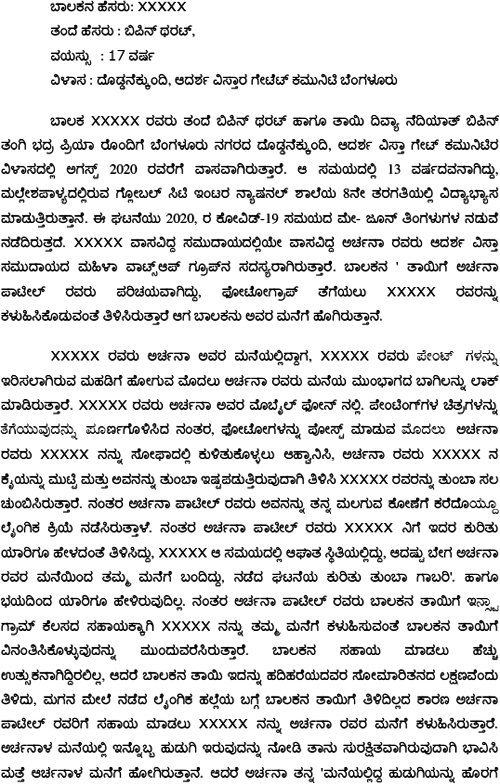
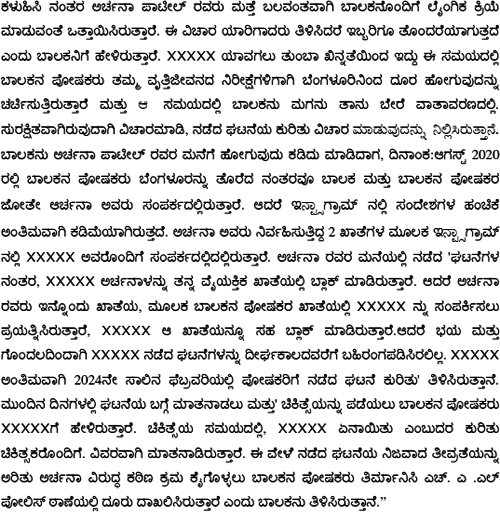
The Police then conduct investigation. The statement of the mother/complainant during the course of investigation is a complete narration of what the boy has gone through all the 4 years psychologically and when he was confronted, gave all minute details of what has happened. The statement of the mother of the victim is as follows:
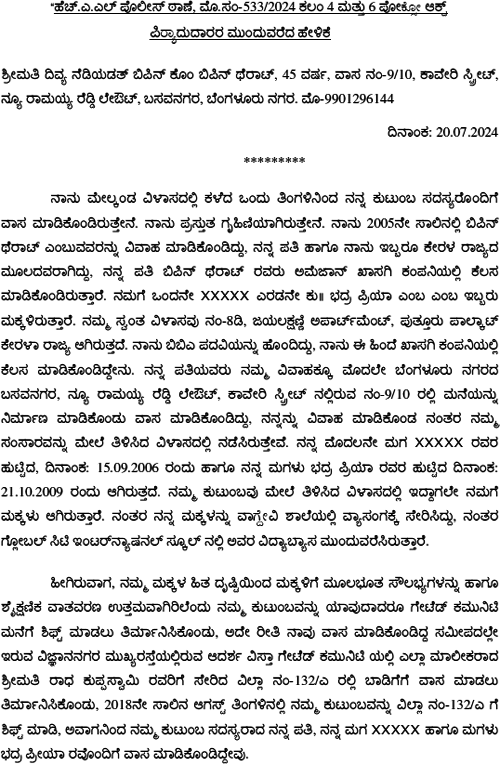
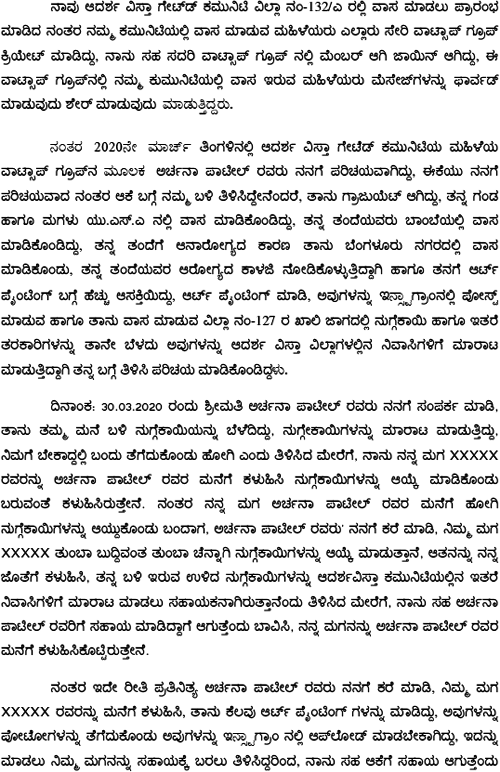
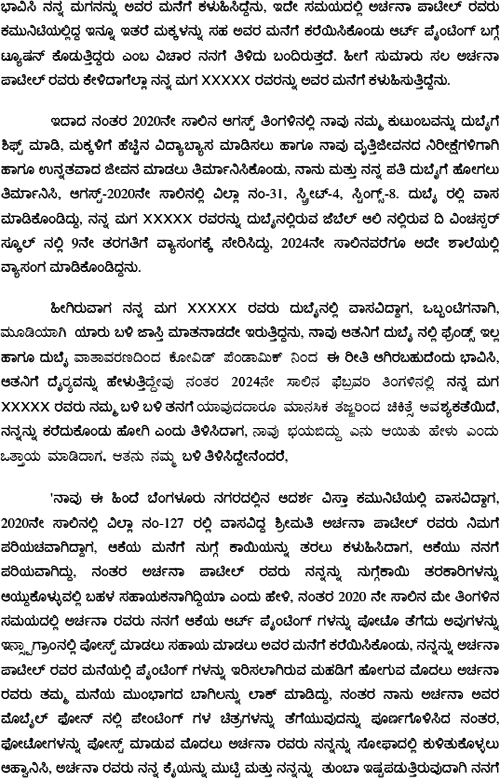
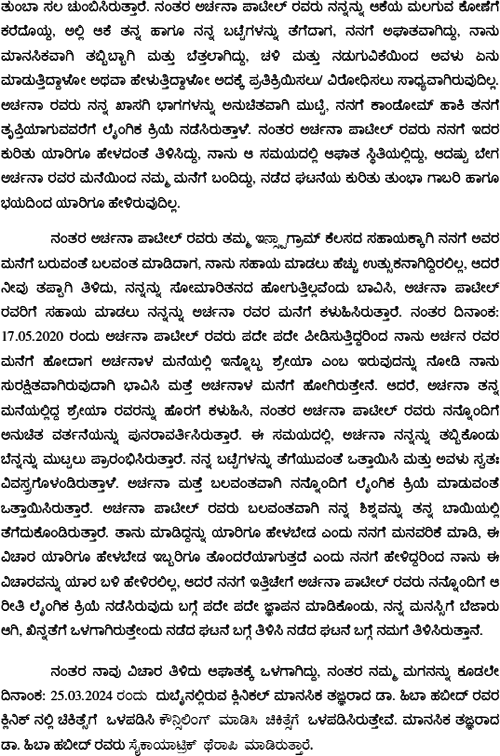
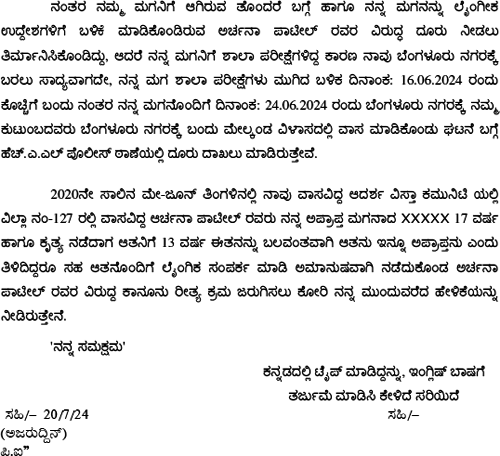
The mother recounts with a heavy heart that though the harrowing incident transpired in the year 2020, it did not fall upon the family's knowledge until 2024, when they were residing in the UAE. When the son gently guided through a course of intensive therapy and psychotropic counseling at Dubai, began the narration long and painful journey. The entire narration is made by the child. In the light of those deeply compelling circumstances, the complaint is registered. All the afore-quoted would lead the Police to file a charge sheet against the petitioner. The summary of the charge sheet as obtaining in column No. 17 is as follows:
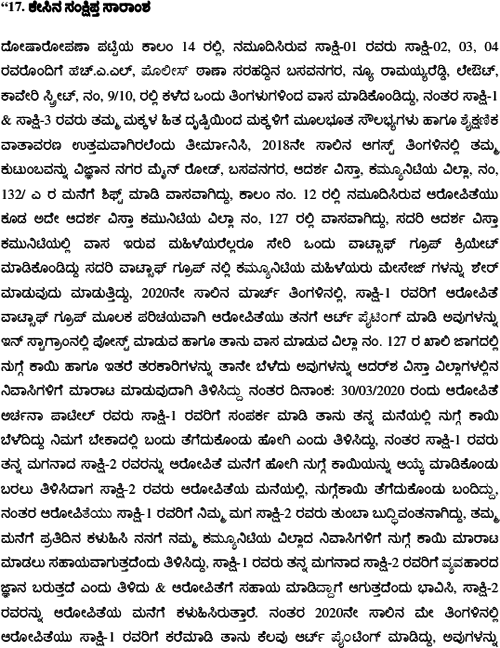
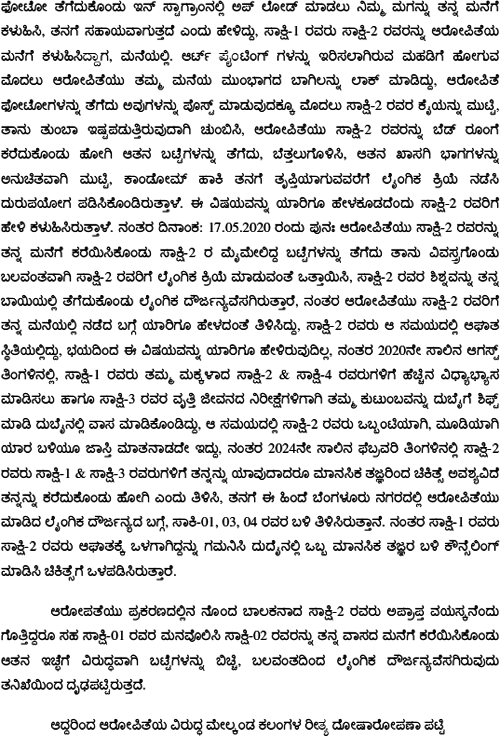

The narration in Column No. 17 supra is in complete detail as to what has transpired between the petitioner and the victim boy.
16. In the teeth of the afore-narrated horrendous facts, the issue would be whether the submission of the learned senior counsel for the petitioner would merit acceptance. Submissions are made that victim boy of 14 years and the petitioner being 48 years cannot become the subject matter of the provisions of the Act. The submission is sans countenance on a plain interpretation of Sections 3 and 5 supra. When the allegations in the complaint, the staements recorded and the summary of the charge sheet are examined through the lens of statutory ingredients, it becomes clear that the boy in question may not have performed the act of penetration on his own volition. The allegation is that the act, woman manipulated or induced the child to penetrate her, this is a circumstance that falls squarely within the ambit of the words in the statute “make the child to do so with her or any other person”. Therefore, this court is of the firm and reasoned opinion that all statutory ingredients of offence under Section 3 stand fulfilled in the present case. To suggest otherwise would be to adopt a reading of the law that is not only narrow and technical but also antiethitical to its remidial purpose. The Act is designed not to serve anatomical formality but to protect the child from sexual abuse. This intent of the legislature cannot be subverted through strained and restrictive interpretations. Therefore, the ingredients of the offence are clearly met in the case at hand for an allegation under Sections 4 and 6 of the Act against the petitioner.
17. It is matter of public record as supported by empirical data that 54.4% of children reporting sexual assault are boys while 45.6% are girls. This statistical reality underscores a critical truth that sexual violence is not confined to one gender. A seminal study conducted as early as in 2007 had already highlighted the above said disturbing trend and as submitted by the learned counsel for the respondents such instances have only escalated expotentionally in the years. Therefore, the report of 2007 and its graphic interpretation is necessary to be noticed. It reads as follows:
“6.2.3 Forms of sexual abuse of children
Sections 6.2.1 & 6.2.2 discuss severe and other forms of sexual abuse collectively. This section discusses individual forms of sexual abuse.
6.2.3.1 Sexual assault:
For the purpose of this study, sexual assault means penetration of the anus, vagina or oral sex. Out of the 12,447 child respondents, 5.69% reported being sexually assaulted. The study conducted by RAHI has also reported a 6% figure for severe sexual abuse (4% penetrating anus or vagina and 2% oral sex). Another study titled Sexual Abuse of Street Children brought into an observation home found that over 15% of the boys in the institution reported penetrative sexual abuse and the maximum proportion of abuse was reported in the age group 8-10 years (42.9%).
Of all the children reporting sexual assault, 54.4% were boys and 45.6% were girls. Out of the total children reporting sexual assault, 37.82% were in the age group of 15-18 years, 36.53% in the age group of 5-12 years and remaining 25.64% in the age group of 13-14 years. Within the age groups, the highest percentage of sexual assault (7.72%) was reported by children in the age group of 15-18 years followed by 5.57% in the age group of 13-14 years and 4.52% in the age group of 5-12 years. Further, in-depth analysis of data on sexual assault of children within different age groups revealed that 16.48% children were in the age group of 6-10 years. This abnormally high percentage of sexual assault of very young children is a matter of concern and needs immediate attention.
(Emphasis supplied)
In the light of the aforesaid report about boys being the victims of POCSO to a large extent, it cannot be said that the offence is committable only by a man, upon a woman. It is apposite to notice certain reports, articles and research papers on this aspect. A research paper on male victims of sexual assault produced by the Department of Counselor Education and Family Studies, of Texas Tech University deals with such behaviour aspects. Certain paragraphs of the study research paper would become necessary to be paraphrased.
“…. …. ….
During the 1980s, there has been a significant increase in the amount of litereature on the topic, indicating that AMSV is not as uncommon as the former paucity of material on the issue suggested [4,24]. The incidence and prevalence of sexual assault against adult men, the reasons behind it, and the psychology underlying victims' involuntary sexual reactions are all covered in this article's examination of the literature. Due in part to the misconception that the victim's erection or ejaculation during the assault constitutes permission, the legal system has been reluctant to offer male sexual assault victims a legal redress, despite the increased awareness of these crimes [4,24].
Although the literature on sexual violence against women is laudable and although it has provided a foundation upon which to explore male victimization [25,26], the latter is an experience that is worthy of investigation. Even though adult male sexual violence (AMSVo) is becoming more widely acknowledged as an issue, the literature unanimously agrees that there is a dearth of information on the subject when compared to information on female victims [27].
This article provides a review of the literature on AMSV. First, we provide the back-ground for our literature search and criteria. Next, a discussion of the numerous definitions is offered on AMSVO and related terms. We examine the literature related to prevalence and barriers for men to report incidents of sexual violence. Biases and misconceptions which impact both the reporting of an incident and response to men who are victims of sexual violence are explored in depth. Research is provided on typical male responses to sexual victimization, populations of men most at risk and risk factors to being violated, the emotional impact on men, help-seeking by men, and implications for treatment to equip counselors with required knowledge on AMSV and to empower them to address challenges facing male victims. Finally, the limitations of this review and recommendations for future directions in this research field are outlined.
…. …. ….
Currently, there have been several definitions used to define sexual assault. Isely and Gehrenbeck-Shim (1997) defined male sexual assault “as any non-consensual sexual acts perpetrated against a man, 16 years or older, by a male or female” (p. 160) [32]. In 2020, the Department of Justice's (DOJ) definition of sexual assault included a range of victimizations and was separate from rape or attempted rape. It includes attacks or threatened attacks involving unwanted sexual contact between victim and offender, with or without force; grabbing or fondling; and verbal threats. Additionally, they define rape as the “penetration, no matter how slight, of the vagina or anus with any body part or object, or penetration by a sex organ of another person, without the victim's consent” (https://www.justice. gov/archives/opa/blog/updated-definition-rape; accessed on 28 March 2023) [33]. The World Health (WHO, 2002) expands the definition beyond physical contact:“any sexual act, attempt to obtain a sexual act, unwanted sexual comments or advances, or acts to traffic, or otherwise directed, against a person's sexuality using coercion, by any person regardless of their relationship to the victim, in any setting, including but not limited to home or work” [27,34].
…. …. ….
4. Barriers to Reporting AMSVo
Male and female victims may decide not to disclose information to protect a friend or family member, out of concern of retaliation by their attacker, and out of concern that they will be blamed personally for their victimization [42,49]. Men may also choose not to report if they have issues with their sexuality. Men are more likely to encounter reporting issues relating to their sexuality given that they are more likely to be victims of other men. Men who have not publicly acknowledged that they are anything other than heterosexual may choose not to report for fear of having to come out. In addition, heterosexual men who were assaulted by other men might not come forward for fear of having their sexual orientation revealed. Another specific rape distortion that affects men is the belief held by the public and healthcare professionals that men cannot be raped [35]. Men may opt not to complain if they are simply going to be informed that what occurred to them did not occur an invalidation of their experience. A lack of knowledge regarding the physiologic reaction to attack and the fact that erection or orgasm can occur even in traumatic situations may contribute to this belief. This false notion may not only prevent people from believing that men may be abused, but it may also prevent men from recognizing victimization when it does.
…. …. ….
4.1. Blaming the AMS Victim
Male victims are perceived to carry a level of blame for not resisting their attacker. Others may question how a man can achieve and maintain an erection and sexually perform if the sexual encounter is a coercive situation. Smith and colleagues (1988) a assess 77 men and 89 women who made a series of judgments about two randomly cases as if they were on a jury [68]. A MANOVA analyzed a 2 (sex of victim) × 2 (sex of assailants) × (sex of subjects). The attributions of victim responsibility found that men were more likely to be assigned blame than female victims. They also found that when the assailant was a female less impact was reported than a male-to-male act. It is hypothesized that if men become aroused and sexually respond to the perpetrator, they wanted and enjoyed it. Given the strong feminist theoretical paradigm and feminist ideology [69], women are classified as victims and men as offenders. Javaid et al. highlight this point by noting some feminists reject male rape to validate women's experience of sexual violence by viewing men as solely offenders [51]. The perceived minimal force needed to overpower female victims mitigated the perceived impact on men. Male victims note that the implication is that “the use of force determines concern about victimization” (p. e20).
Male victim bias perpetuates victim blaming. Specifically, the acceptance of male rape was a strong predictor of victim blaming, suggesting that acceptance of stereotypical ideas about male rape means that a person is more likely to engage in male victim blaming behaviors. This is of concern, particularly as it is likely that these falsehoods regarding male rape are accepted widely [70], as confirmed within this study with high levels of acceptance of certain misconceptions or false beliefs on male rape. This finding is supported by Kassing et al. (2005) and Johnson et al. (2006) [65,66].
4.2. Accusations of Homosexuality against Adult Men
Another masculine-related misconception is that men are sexually assaulted by homo-sexuals, perpetuating the false belief that sexual violence is about sex and only committed by homosexual men and victims are primarily homosexual [51,71,72]. Similarly, it is often thought that women do not assault men, leaving the perpetration of male sexual victimization to men. Accepted stereotypes that homosexuals solely assault men and only gay men are victims facilitate the inaccurate understanding and poor handling of male victims [51,71,72].
4.3. Female Perpetrators of AMSVo
The first systematic report on adult male victims was by Sarrel and Masters (1982) who interviewed men who reported women perpetrating sexual assault [24]. The researchers noted psychological distress, post-trauma reactions, and impaired sexual functioning. Later studies found that gay men are more likely than women to have pro-victim judgments and endorse male rape falsehoods, including victim blaming [56,57,66].
…. …. ….
8. The Emotional Impact on Male Victims
8.1. Mental Health Problems
In the search focusing on male sexual victimization, distinct differences between male and female survivors began to emerge. As a result of victimization, men may experience a profound emotional disruption. Psychologically, victimization is especially trauma-producing for men [42,116]. Walker and colleagues interviewed 40 male rape survivors, leading to a detailed and descriptive analysis of the impact of the assault on men [56,57]. During the incident, men reacted with freezing, fear, helplessness, and sub-mission. About 27% reported that they fought back without success. In the aftermath of the assault, they identified both short-term and long-term effects. Studies have also identified higher rates of mood disturbances, anxiety, suicidal ideation and behavior, non-suicide self-injury, grief and loss reactions, drug abuse, somatic problems sleep difficulties, sexual difficulties, increased changes in self-perception, social dysfunction, stigma, shame, lower self-esteem, hostility, fantasies about revenge, and an increase in a sense of vulnerability [41,53,56-58,89,116,123-125]. Post-traumatic stress disorder and rape trauma syndrome have also been noted. Self-blaming also affects how people respond to the victim, being perceived as less well-adjusted and more responsible for the rape than those who do not [32,114,126,127].”
The afore-quoted research paper is indicative of barriers reporting male sexual abuse and accusations of homosexuality against adult men. In the light of the preceding analysis, as also the report/research articles quoted hereinabove, would clearly indicate that even boys and men are victims of sexual assault at the hands of either the person of the same gender or of the opposite gender. Therefore, on all the praedictus analysis, the ingredients of Sections 4 and 6 of the Act are completely met in the case at hand. The issue is answered accordingly.
Issue No. 4:
(iv) Whether delay in registration of the crime, has vitiated the entire proceedings?
18. The complaint, the statements, the charge sheet and the statement of the mother are all extracted hereinabove. The mother recounts the incidents that transpired in the year 2020 and contends that the victim was in a state of shock even to reveal what has happened and has garnered courage to come forward and narrate the agonizing incident to the mother. The offences as mentioned hereinabove are grave. Delay in reporting such grave offences is not uncommon. The mind of a child sometimes is in a state of shock and in such state would not adhere to legal clocks. The trauma endured is invisible and insidious, and such trauma may sometimes lead to silence, which may span years. Once clarity and courgage converged, the child has overcome the silence of the years, and has narrated the events to the mother. The mother then flies back to India and registers the crime at which point in time, the victim was still 17 years. Therefore, in cases where the ingredients of sexual assault and penetrative sexualassault of a victim, be it a boy or a girl, who was tramatized at a tender ge of 13½ years would not naturally gather courage to report the incident that is considered a taboo in the society. Therefore, delay as projected by the learned senior counsel for the petitioner, would not vitiate the proceedings particularly, owing to the boy becoming a victim of alleged grievous offence. In fact, delay of the proceedings, is at best a matter of evidence. Whether, delay would be justifiable or unjustifiable is a matter of trial. The proceedings cannot be obliterated on the score of delay in registering a crime of this kind, when the narration in the complaint, the statement of the victim and the statement of the mother depict vivid and gory details of the incident or incidents, as the case would be. Whether delay in a case concerning the offences under the Act can be considered to quash the proceedings in exercise of jurisdiction under Section 482 of the Cr. P.C., bears consideration by different High Courts. The High Court of Calcutta in the case of SHREEKANT SHARMA v. STATE OF WEST BENGAL2, has held as follows:
“…. …. ….
16. The prosecution argues that there was a delay in filing the FIR because the victim was not believed by her own father when she informed him about the activities of his accused uncle. As soon as the first incident occurred during the festival of Rakshabandhan, 2018, she informed her father without delay, but he accused the victim of being a liar. As a result, when she was again assaulted after Diwali, 2019, she did not tell her father. Moreover, she did not inform her mother as she was going through matrimonial disputes for a long time and she herself was a victim of domestic abuse. But eventually when the victim confided in her brother and both of them went to confront their father, he assaulted his son and filed a complaint against them. They were made to sit in the police station for long hours as they went to complain and threatened there as well. After this incident, their own father lodged a complaint against them. The victim confided in her mother only after she decided to return to her matrimonial home as the MoU failed to reach a logical conclusion. She confided in her mother as she was afraid that she would have to go back to that place where she was assaulted twice. Therefore, there are enough reasons why there was a delay in FIR.
17. The learned Counsel then argued that the consent not given for medical examination should not be a ground for quashing the FIR against the accused. In this particular case of sexual assault no penetrative act done by the accused on both occasions. On the first occasion, the accused touched the breasts and private parts of the victim without consent and on the second occasion, the victim was forced by the accused to touch his private parts. Therefore, it is apparent that medical examination by the doctor cannot prove whether these acts had been committed by the accused. This reason cannot be cited for quashing the FIR and investigation against the accused persons.
18. Having heard the counsels for both the petitioners and the complainant/opposite parties, the Court cannot quash the FIR and investigation under Section 482 of the Code of Criminal Procedure.
19. The counsels for the petitioner/accused, Mr. Shreekant Sharma argue that he was neither a party nor a witness to the ongoing dispute between Narayan Sharma and Jyoti Sharma and that he is caught in the cross-fire between the parties and that he would never have been accused if the MoU between his nephew and his wife would have reached a logical conclusion. However true may that be, it cannot be a reason for this court to quash the investigation proceedings against him. The allegation of sexual assault is different and not in any way related to the disputes between the parents of the victim. The two incidents of sexual assault, one during Rakshabandhan in 2018 and the other after Diwali in 2019 are not related to the ongoing matrimonial dispute disputes between the parents of the victim. The accused perpetrated this alleged heinous act on the victim when her mother was out of the station on both these occasions. Moreover, it is not that the accused was not at all involved with the family of the victim. Firstly he was a close relative of the victim, being the uncle of his father, Narayan Sharma and secondly, both the accused and his father were in the same profession, therefore, they were frequently in contact for matters related to their profession. In her statement recorded on 01.08.2021, the victim said that the accused used to visit her house twice every week. Therefore, it would be completely wrong to say that the accused was not at all involved in the family's affairs as his place of residence was different, as it is apparent that he visited the victim's house multiple times.
20. Next the issue under consideration for this Court is whether a delay in filing FIR by the victim should be a cogent reason for quashing the investigation against the accused and the co-accused. This Court is inclined to answer in the negative as there is a catena of judgments by the Supreme Court, as well as High Courts which hold that delay in filing F.I.R. in cases of sexual assault, should not be equated with other cases to quash proceedings or hold an accused not guilty. The Supreme Court, in Satpal Singh v. State of Haryana, (2010) 8 SCC 714 held that:
“13. In a rape case the prosecutrix remains worried about her future. She remains in traumatic state of mind. The family of the victim generally shows reluctance to go to the police station because of society's attitude towards such a woman. It casts doubts and shame upon her rather than comfort and sympathise with her. Family remains concern about its honour and reputation of the prosecutrix. After only having a cool thought it is possible for the family to lodge a complaint in sexual offences. (Vide Karnel Singh v. State of M.P. (1995) 5 SCC 518 : AIR 1995 SC 2472; and State of Punjab v. Gurmeet Singh (1996) 2 SCC 384 : AIR 1996 SC 1393).
14. This Court has consistently highlighted the reasons, objects and means of prompt lodging of FIR. Delay in lodging FIR more often than not, results in embellishment and exaggeration, which is a creature of an afterthought. A delayed report not only gets bereft of the advantage of spontaneity, the danger of the introduction of a coloured version, an exaggerated account of the incident or a concocted story as a result of deliberations and consultations, also creeps in, casting a serious doubt on its veracity. Thus, FIR is to be filed more promptly and if there is any delay, the prosecution must furnish a satisfactory explanation for the same for the reason that in case the substratum of the evidence given by the complainant/informant is found to be unreliable, the prosecution case has to be rejected in its entirety. [vide State of Andhra Pradesh v. M. Madhusudhan Rao (2008) 15 SCC 582].
15. However, no straight jacket formula can be laid down in this regard. In case of sexual offences, the criteria may be different altogether. As honour of the family is involved, its members have to decide whether to take the matter to the court or not. In such a fact-situation, near relations of the prosecutrix may take time as to what course of action should be adopted. Thus, delay is bound to occur. This Court has always taken judicial notice of the fact that “ordinarily the family of the victim would not intend to get a stigma attached to the victim. Delay in lodging the First Information Report in a case of this nature is a normal phenomenon” [vide Satyapal v. State of Haryana (2009) 6 SCC 635 : AIR 2009 SC 2190].”
21. In State of Himachal Pradesh v. Prem Singh, (2009) 1 SCC 420 : AIR 2009 SC 1010, the Supreme Court considered the issue at length and observed as under:—
“So far as the delay in lodging the FIR is concerned, the delay in a case of sexual assault, cannot be equated with the case involving other offences. There are several factors which weigh in the mind of the prosecutrix and her family members before coming to the police station to lodge a complaint. In a tradition bound society prevalent in India, more particularly, rural areas, it would be quite unsafe to throw out the prosecution case merely on the ground that there is some delay in lodging the FIR.”
22. The Bombay High Court in State of Maharashtra v. Savala Sagu 1997 Bom CR Cri, 1997 Cri LJ 786 observed that:
“15. We wish to emphasise that any unmarried girl on account of her bashfulness and the circumstance that not only her own honour but that of her family was at stake, would have been extremely reluctant and loath to disclose to the police, her traumatic experience of being raped. It is only after efflux of time, when she is able to get over a part of her trauma, will she think of lodging the FIR. In our view, no mathematical time limit in lodging an FIR can be fixed in cases of rape. Courts in such cases should adopt a realistic approach rather than one which is unimaginative and theoretical. After all our conduct in life is governed by brass realities.”
23. In X v. State of Kerala Crl. A. No. 649 of 2021, decided on 01-07-2022, the Kerala High Court observed that:
“The delay in a case of sexual assault cannot be equated with a delay in a case involving other offences since several factors weigh on the mind of the victim and members of her family. In a tradition-bound society like ours, particularly in rural areas, it would be quite unsafe to throw out the prosecution case merely on the ground that there was a delay in lodging the FIR.”
24. In the Supreme Court's decision of Tulsidas Kanolkar v. State of Goa, (2003) 8 SCC 590, where the victim of rape was a mentally challenged person and there was a delay in reporting the crime, the Court took into consideration the unusual circumstances while holding the accused guilty and observed that:
“We shall first deal with the question of delay. The unusual circumstances satisfactorily explained the delay in lodging of the first information report. In any event, delay per se is not a mitigating circumstance for the accused when accusations of rape are involved. Delay in lodging first information report cannot be used as a ritualistic formula for discarding prosecution case and doubting its authenticity. It only puts the court on guard to search for and consider if any explanation has been offered for the delay. Once it is offered, the Court is to only see whether it is satisfactory or not. In a case if the prosecution fails to satisfactory explain the delay and there is possibility of embellishment or exaggeration in the prosecution version on account of such delay, it is a relevant factor. On the other hand satisfactory explanation of the delay is weighty enough to reject the plea of false implication or vulnerability of prosecution case. As the factual scenario shows, the victim was totally unaware of the catastrophe which had befallen to her. That being so, the mere delay in lodging of first information report does not in any way render prosecution version brittle.”
25. The victim attained majority on 08.07.2021, but when the acts of sexual assault were committed she was a child of 15 and 16 years old respectively. Her statement was recorded on 01.08.2021 after she turned 18 years old, and therefore this Court has everyreason to believe that she was fully aware of what she was saying in the statement, where she described in quite detail the heinous act committed on her. In her statement, she says that after the first incident happened, she immediately called her father and told him everything and instead of believing her, he totally shut her down and accused her of lying andhaving a “dirty head who is misunderstanding things”. Subsequently, the accused also denied everything. At that point in time, she did not inform her mother as she herself was going through marital problems. Then again in 2019, a few days after Diwali, the accused assaulted her again and threatened not to tell anyone. In June 2020, the victim told everything to her brother and when they went to confront their father for not believing and supporting her, he allegedly slapped him, after which her brother took her to the police station where they were made to sit for long hours and their father and uncle were called. Hereafter on 04.06.2020, their father Narayan Sharma registered a FIR against the victim and her brother, due to which the brother was detained and later released on bail. Then again on 23.09.2020, accused no. 2 again complained against his son and his daughter, the victim in Phoolbagan Police Station. After this, the mother, Jyoti Sharma, the complainant moved out of her matrimonial home with her three children. When the accused persons were not complying with the terms of the MoU and the complainant decided to return back to her matrimonial home, the victim decided to disclose everything to her mother as she did not want to go back to the place where such heinous crimes were committed on her. After this, the complainant lodged F.I.R. against the accused.
26. Therefore, it is not that the victim did not try to raise a complaint against the accused after the act was committed. She at once informed her father, who did not believe her. Therefore, she could not confide in him again after she was violated the second time. When she informed her brother, they were threatened by her father and his family and when they went to file the FIR in the police station, they were threatened there as well. Therefore, there seems to be a cogent reason for the delay in filing the FIR. Moreover, as seen from the series of cases cited above it is the opinion of the Courts that the delay in FIR cannot be a reason for acquitting an accused person and this Court is of the opinion that technical grounds cannot be cited as a reason for quashing of the investigation at this stage in a heinous crime like sexual harassment of a girl child. There are a plethora of reasons why victims of sexual assault do not come forward with allegations. Firstly, they are discouraged from filing F.I.R. and are not believed by the authorities. This is coupled with the social stigma that a woman and her family face from society when such an act is committed against her. More importantly, sexual harassment and rapes are crimes which can cause lifelong trauma to the victims and it is impossible to mathematically calculate or prescribe a time limit as to when a person would recover and would be comfortable with filing a complaint. This Court is not inclined to believe the allegations of the accused and believes that there was sufficient reason which explained the cause of delay in filing the FIR.
(Emphasis supplied)
A Special Leave Petition filed against the said judgment is also rejected by the Apex Court. The Calcutta High Court clearly holds that non-reporting of the offence by the victim or non-registration of the complaint immediately after the incident, cannot become the reason for quashment of the proceedings under Section 482 of the Cr. P.C. I am in respectful agreement with the judgment rendered by the Calcutta High Court. Therefore, delay in lodging the FIR, in cases of sexual assault concerning a child, cannot be equated with the case involving other offences. There are several factors which weigh in the mind of the victim and the family members before walking to the police station, to lodge a complaint. The delay, in the considered view of the Court, has not and cannot, in the peculiar facts of the case, lead to obliteration of the proceedings. The issue is accordingly answered.
Issue No. 5:
(v) Whether non-conduct of a potency test of the victim has vitiated the entire proceedings?
19. The contention with regard to non-conduct of potency test of the victim is projected in buttressal of quashment of the proceedings. Heavy reliance is placed on the concept of potency test. It is the submission of the learned senior counsel that potency test is not conducted in the case at hand. Therefore, it is not known as to whether he had attained puberty or not, or got erection or not or was capable of penetration or not. This submission is also noted only to be rejected. The Division Bench of the High Court of Madras in the case of KAJENDRAN J. v. SUPERINTENDENT OF POLICE3 has held as follows:
“…. …. ….
21. The above guidelines that have now been issued sufficiently satisfies the directions issued by us on 07.07.2023 and 14.08.2023. We expect the above guidelines to be strictly followed and any violation of the same must entile consequences of initiating appropriate proceedings as directed by the Hon'ble Supreme Court.
22. In so far as the male potency test is concerned, the following standard operating procedure has been issued:
“*Male Potency test need not be undertaken in a routine manner in all cases involving sexual offences.
1. If the accused person raises impotency as a defence, the burden of proof will be upon the accused person to prove that he is impotent. Only in such instances there is requirement for conducting the potency test.
2. The doctor must in rare cases adopt invasive methods to find if the man had consumed any pill or other medication and committed penetrative sexual violence where otherwise he is impotent.
3. Even in cases, as the semen may be traced in the victim or in her undergarments etc, it is enough if the blood sample of the offender is taken and the DNA is matched. It is not necessary to draw the semen from the accused person.”
23. We expect the above procedure to be followed without any default. The potency test that has been practiced for a long time without any valid reasons, must be stopped forthwith and the standard operating procedure that has been issued pursuant to our orders, must be strictly complied with.
24. The learned Additional Public Prosecutor submitted that the details of the 111 cases that have been identified, is in the process of being collated and the police officers are in the process of getting in touch with the complainant/parent of the victim girl to see if they are consenting for bringing to an end the concerned criminal proceedings. We are inclined to grant some more time in this regard.”
(Emphasis supplied)
The Division Bench holds that male potency test need not be undertaken in a routine manner in cases involving sexual offence. It is trite law that such submissions should undoubtedly be tried and tested in evidence. They cannot become the reason for quashment of the proceedings in exercise of jurisdiction under Section 482 of the Cr. P.C. It is at best a ground that can be projected before the concerned Court. The issue is accordingly answered.
20. Advancing his submissions to their farthest stretch, the learned senior counsel has sought to impress upon this Court an archaic notion, that in a sexual intercourse the male is ever an active agent and the woman forever is a passive recipient. Such a view, steeped in antiquated stereotypes finds no foothold in the present day and is therefore, noted only to be rejected, as the law acknowledges applicability to both man and woman. An intertwined submission is made that in a state of shock there would be no erection, and if there is no erection, there can be no penetration. This submission is noted only to be rejected. State of shock is a psychological concept. Erection is purely a physiological or a biological concept. Psychological concepts would not sometimes control physiological and biological actions. The report covers the aspect of delay, shock and other contentions of the learned senior counsel for the petitioner.
21. An article published by the Texas University on male victims of sexual assault : phenomenology, psychology and physiology would throw certain light on the aspect of male assault victims and sexual response. The relevant extracts of the report are germane to be noticed. It reads as follows:
“…. …. ….
Male Assault Victims and Sexual Response
Groth and Burgess noted that a major strategy used by some offenders in the assault is to get the victim to ejaculate, which may symbolize to the offender his ultimate and complete control, may confirm the offender's fantasy that the victim actually wanted the assault, may bewilder the victim and discourage the victim from reporting the assault, and may impeach the victim's credibility of his allegation of nonconsent in trial testimony. In the words of one of the victims the authors interviewed:“I always thought a guy couldn't get hard if he was scared, and when this guy took me off it really messed up my mind. I thought maybe something was wrong with me. I didn't know what it meant and this really bothered me.” Other studies cite similar anecdotal evidence of involuntary arousal. Huckle noted that men were particularly disgusted with themselves if they ejaculated during the rape. Mezey and King noted:“An extreme form of loss of control is demonstrated by those victims who were physiologically aroused while being terrorized. This would accord with other findings which suggest that sexual arousal may be provoked by extreme anxiety” (Ref. 30, p 208). Multiple other authors have referred to the phenomenon of involuntary arousal and ejaculation by the male victim of sexual assault. Coxell and King noted that the legal community has assumed that a man cannot obtain an erection involuntarily, however, King and Woollett note that “just under 20 percent of the men were stimulated by their assailant until they ejaculated. This is a particularly difficult issue for victims, especially when cases are brought before the courts… as these events may be regarded as a form of consent by lawyers” (Ref. 37, p 587).
Indeed, as discussed by Fuchs in his excellent review, the justice system has been unwilling to provide legal remedy to male victims of sexual assault. The lack of judicial concern for male victims appears strongly influenced by the idea that having an erection or ejaculating signifies consent. Fuchs cites cases of court opinions in the United States, United Kingdom, and Canada attesting to the assumption that penile erection implies consent. For example, in invalidating New Hampshire's gender-specific statutory rape statute under the Equal Protection Clause of the Fourteenth Amendment, the First Circuit Court defined sexual contact as “any penetration, however slight,” thus asserting that prepubescent males are capable of being sexually assaulted in violation of the statute without obtaining a full erection. The implication is that a full erection would signify that the sexual contact was consensual : The First Circuit “sought only to protect male victims who maintain partial erections during their attacks… [males] who are able to maintain full erections during their sexual assaults would be left without a cognizable legal remedy” (Ref. 6, p 110). Fuchs cites instances in the United Kingdom and Canada of cases being dismissed because the victim of a sexual assault maintained an erection : one where a judge in the United Kingdom dismissed a case because the victim of a prison rape admitted that he had an erection while being raped; another U.K case, in which a judge instructed the jury to acquit a defendant charged with forcible sodomy, solely on the basis that the victim had an erection during the assault, which the judge accepted as a “defense of submission”; and a Canadian case where a court held that maintaining an erection may be reasonably interpreted as consent (Ref. 6, pp 113-14).
…. …. ….
Conclusions
Although sexual assault of males occurs much less frequently than that of females, it is neither rare nor limited to all-male populations, such as those in jails and prisons. As with females, sexual assault of males occurs more frequently in the victim's second or third decade. The available comparisions between male and female victims show that male and female victims are assaulted by strangers at about the same rate, but that males are more likely to have more than one assailant. The studies that address the sexual orientation of male victims find higher percentages of victims who identify as gay, bisexual, or having consensual sex with men. However, these populations also tend to be more highly represented in the samples of the studies where this is shown. Many assaults of males involve anal rape.
The circumstances in which sexual assaults of men take place are varied. As with women, men are assaulted by acquaintances (including recent acquaintances), lovers, friends, family members, and total strangers. The motivations of the assailants are varied, and include demanding sexual gratification from a lover, partner, or recent acquaintance; exorcising intensely conflicted feelings about sexual orientation; humiliating the victim, sometimes as a form of gay-bashing; and exercising power and control over the victim. An extreme form of power is expressed in the victims’ having an erection or ejaculating during an assault. Studies of the physiological mechanisms governing erection and ejaculation suggest that these can occur in the context of nonconsensual receptive anal sex. Erections and ejaculations are only partially under voluntary control and can take place during times of extreme stress or duress.
It is imperative that attorneys and forensic psychiatrists base their reasoning on scientific fact, both phenomenological and physiological. Otherwise, male victims of sexual assault are confronted by false assumptions by those whom they must depend on if they come forward to report such a crime. Such false assumptions can easily result in disbelief that the event even occurred, or, if it did, the assumption that it was consensual, particularly if there is evidence that the victim experienced an erection or ejaculated during the assault. The reality is that human physiology explains the involuntary aspects of both erection and ejaculation. Understanding of this reality is critical if victims of male sexual assault are to receive justice in legal settings and appropriate services in the community.”
(Emphasis supplied)
The report indicates that human mind and body do not obey rigid binaries of psychological impact controlling physiological result. Physiological coercion wielding its force may compel the body to respond even under the shadow of fear. The report further indicates that the reality is that the human physiology explains the involuntary aspects of both erection and ejaculation. In that light, the submission of the learned senior counsel, that when in fear there cannot be erection and when there cannot be erection, there cannot be penetration, is sans countenance.
22. Therefore, none of the submissions of the learned senior counsel for the petitioner, however artfully presented or obfuscating in tenor, persuade this Court to countenance those contentions. The case stands cloaked in disputed questions of fact, where the offences alleged strike at the core of penetrative and aggrevated penetrative sexual assault, such proceedings cannot be erased with a mere stroke of pen. The trial, in such cases, is not a perfunctory ritual, but imperative necessity. It is for the petitioner to come out clean in its full blown form.
23. Thus, all the arguments raised by the learned senior counsel for the petitioner would crumble, when weighed against the bulwarks of the statute, the charge sheet and the societal need to ensure justice to the voiceless. This Court cannot snuffout the trial before its inception.
SUMMARY OF FINDINGS:
Ø The Act, being a progressive enactment, is intended to safeguard the sanctity of childhood. It is rooted in gendral neutrality with its beneficient object being the protection of all children, irrespective of sex. The Act is thus, gender neutral.
Ø Sections 3 and 5 which form the foundation for offences under Sections 4 and 6 of the Act, delineate various forms of assault. Although certain provisions may employ gendered pronouns, the preamble and purpose of the Act, render such usage inclusive. Therefore, it is inclusive of both male and female.
Ø The ingredients of Section 4 of the Act dealing with penetrative sexual assault are equally applicable to both men and women. The language of the provision clearly indicates inclusivity.
Ø The ingredients of the offences, the ones punishable under Sections 4 and 6 of the Act, are clearly met in the case at hand.
Ø Delay in registration of the crime, in the case at hand, cannot become the reason for quashment of the proceedings, owing to the alleged offence and the age of the victim.
Ø The submissions of psychological impossibility and absence of potency testing, fall flat in the light of modern jurisprudence, noted hereinabove.
Ø The submission that psychological trauma cannot result in an erection would tumble down, in the light of several studies, that psychological trauma does not always prelude physiological or biological reactions, especially ones of coercion and fear.
Ø The submission that, in an intercourse the woman is only a passive participant and a man is an active participant is noted only to be emphatically rejected, as the thought itself is archaic. The jurisprudence of the present times embraces the livid realities of victims and does not allow stereotypes to cloud legal scrutiny.
24. Therefore, none of the submissions made by the learned senior counsel would merit any acceptance, wherefore, finding no merit in the petition, the petition stands rejected.
It is made clear that the observations made in the course of the order are only for the purpose of consideration of the case of the petitioner under Section 482 of the Cr. P.C. and does not bind or influence the proceedings pending against the petitioner before the concerned Court.
———
† Principal Bench at Bengaluru
‡ This Criminal Petition is filed under Section 482 of Cr. P.C., (Under Section 528 of Bharatiya Nagarik Suraksha Sanhita) praying to A. Quash the FIR Registered in Crime No. 533/2024 of Hal Police Station, Bengaluru for the Offences P/U/S 4, 6 of Pocso Act pending in Fast Track Court-I, City Court Complex Bengaluru as an abuse of process of law as per Annexure ‘A’; B. Quash the charge sheet filed in Spl.C.C. No. 2050/2024 on the file of the Hon'ble Additional City Civil and Sessions Judge, Bengaluru City FTSC-I Which is arising out of FIR Crime No. 533/2024 of Hal Police Station as per Annexure-‘C’ as an abuse of process of law and etc.

No comments:
Post a Comment